
How MiSight Contact Lenses Work for Kids
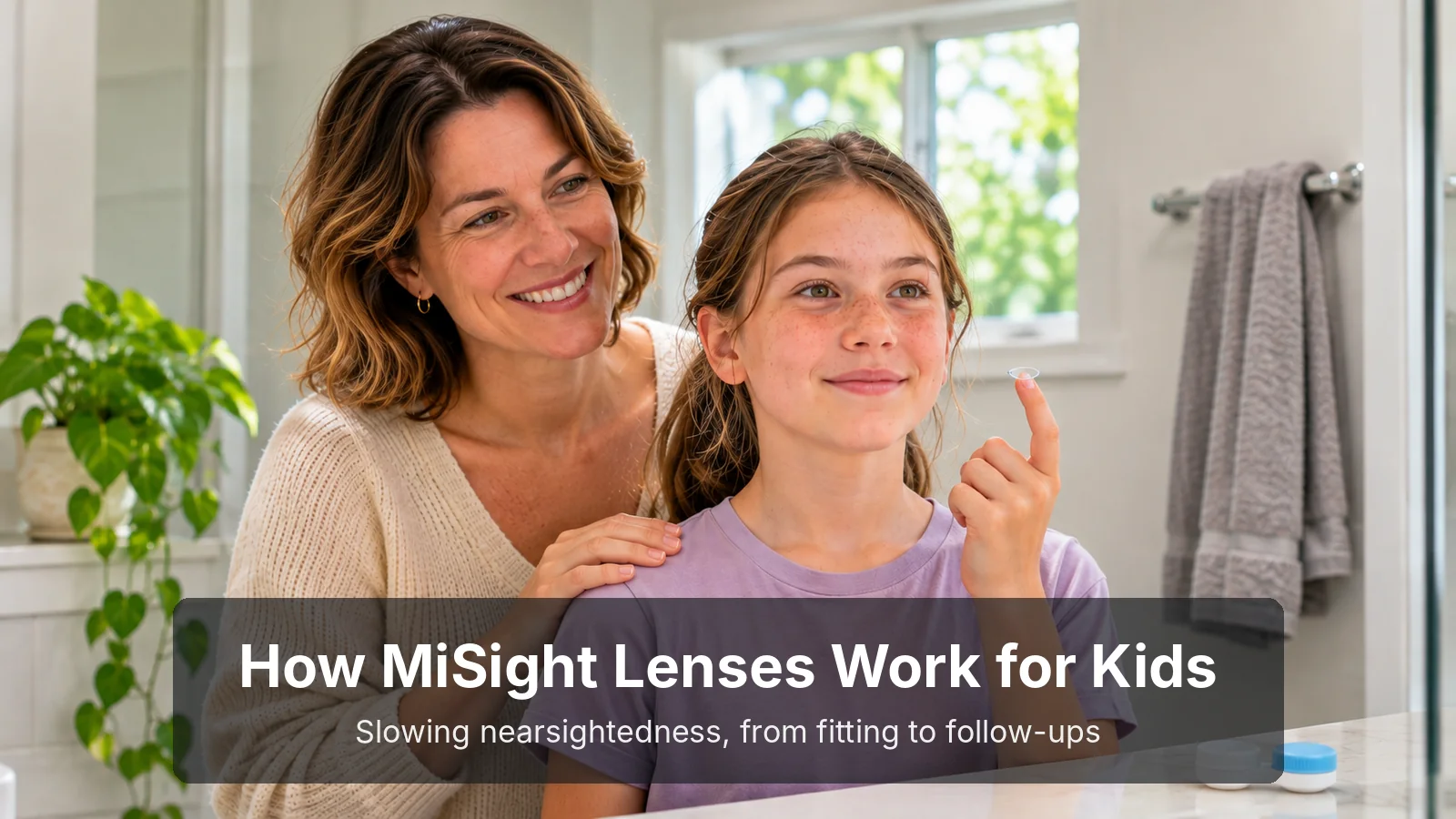
If your child's glasses prescription gets stronger every year, you may be wondering whether a contact lens can do more than help them see the board. MiSight contact lenses are daily disposable soft lenses used in myopia control for kids: they correct blurry distance vision and slow how quickly nearsightedness progresses during the school years.
How MiSight Contact Lenses Slow Eye Growth
Nearsightedness in children usually gets worse because the eye grows too long from front to back. The longer the eye, the stronger the prescription, and higher levels of myopia are linked to more eye health risks later in life. If you want a refresher on what causes nearsightedness in children, that background helps explain why slowing eye growth matters.
MiSight 1 day lenses, made by CooperVision, use what is called a dual-focus design:
- A clear central zone corrects distance vision, just like a regular soft contact lens.
- Ring-shaped treatment zones around the center bring some light into focus in front of the retina.
- That shift in focus is thought to send a signal that slows the eye's lengthening over time.
The lenses are worn once and thrown away at the end of the day, so there is no cleaning case or solution routine to manage. MiSight is the first and only soft contact lens approved by the FDA to slow the progression of myopia in children.
Which Children Are a Good Fit for MiSight?
The FDA approval covers children who start treatment between ages 8 and 12, so the lens is not an option for every child the practice sees. Published product information lists a prescription range of roughly -0.75 to -4.00 diopters of nearsightedness, with only a small amount of astigmatism. Your child's eye doctor confirms whether their eyes fall within that range.
Beyond the numbers, readiness matters. A good candidate is usually a child who:
- Is motivated to wear contacts, or at least curious about them
- Can follow a daily routine with a parent's help at first
- Plays sports or activities where glasses get in the way
- Has healthy eyes and no ongoing eye infections or irritation
At Fox Run Eye Care, Dr. Amy Catalano Boyer and Dr. Susan Gallant-Behan see children from about age 6 and up. For younger children who are not yet ready for contacts, glasses designed to slow myopia may be discussed instead.
What the Research Shows So Far
MiSight was studied in a three-year randomized clinical trial published in 2019. Children wearing MiSight had about 59 percent less myopia progression than children wearing standard single-vision soft lenses. Follow-up data to six years showed continued slowing with ongoing wear.
Two cautions are worth keeping in mind. Results vary from child to child, and no lens can stop myopia completely or guarantee a specific outcome. For general, plain-language information about nearsightedness and children's eye health, the American Academy of Ophthalmology is a reliable place to read more.
How Long Should Kids Wear MiSight Each Day?
The manufacturer's guidance is to wear them at least 10 hours a day, at least 6 days a week. In clinical studies, children often wore their lenses longer than that.
Wear time is where the slowing effect comes from, so consistency counts more than perfection. A simple routine helps:
- Put the lenses in before breakfast so they are in for the whole school day.
- Take them out before bed and throw them away.
- Keep a backup pair of glasses for sick days or any time the eyes feel irritated.
MiSight lenses are not made for sleeping. They come out every night.
Is Vision Clear With MiSight Lenses?
Studies report that distance vision with MiSight is comparable to standard single-vision soft lenses. Some children notice mild halos or glare around lights at first, especially at night. This usually settles in the first few days or weeks as the brain adjusts to the lens design.
If blurry vision or halos continue past the adjustment period, tell your child's eye doctor. A different lens power or a follow-up check may be needed.
Can an 8-Year-Old Handle Contact Lenses?
This is often the biggest worry for parents. In the MiSight research, most children learned to put in and take out their lenses on their own within the first month. Many kids learn faster than their parents expect, partly because they are motivated to skip glasses during sports and play.
Parents still play a part, especially early on. Supervising insertion and removal, checking that hands are washed, and making sure old lenses go in the trash all build good habits.
Fitting, Training and Follow-Up Visits
Getting started typically involves a few steps:
The eye exam and lens fitting
Your child's doctor checks their prescription and eye health, then confirms whether MiSight is a good match. The fit and comfort of the lens are evaluated on the eye.
Learning to handle the lenses
Your child practices putting the lenses in and taking them out, with step-by-step guidance on hygiene and daily care.
Ongoing check-ins after the fitting
Myopia can change quickly in growing children, so regular follow-up visits are part of the plan. Your doctor will recommend how often your child should come back based on their eyes and how the lenses are working.
At Fox Run Eye Care, our front desk team helps families with contact lens questions, ordering lenses and scheduling contact lens exams. Our office in Greenland is 5 minutes from Portsmouth and a short drive from Stratham, Exeter, Rye, North Hampton, Newington and Dover.
Safety Habits for Kids Who Wear Contacts
Daily disposable lenses lower the hassle of cleaning, but good habits still protect the eyes. No eye infections were reported in the six-year MiSight study, and careful daily routines help keep it that way.
- Wash and dry hands before touching the lenses.
- Never sleep, nap or shower in contact lenses.
- Keep lenses away from pools, lakes, hot tubs and tap water.
- Never reuse a lens or share lenses with a friend.
- Use goggles or protective eyewear for sports where the eyes could be hit.
Take the lenses out and call the office if your child has a red or painful eye, unusual sensitivity to light, discharge, or blurry vision that does not clear. Our doctors can check and treat contact lens irritation and eye infections.
What Happens If a Child Stops Wearing Them?
When a child stops wearing MiSight, myopia generally returns to progressing at its natural rate for that child. The slowing that already happened is not undone, but the extra benefit stops. That is why doctors usually recommend continuing through the years when nearsightedness tends to change the most, then reviewing the plan as your child gets older.
MiSight vs. Glasses and Other Approaches
Parents researching options may come across several approaches to slowing myopia, including special eyeglass lenses, orthokeratology (overnight reshaping lenses) and low-dose atropine eye drops. Each has its own pros and cons, and not every practice offers every option.
At Fox Run Eye Care, Dr. Amy Catalano Boyer and Dr. Susan Gallant-Behan offer MiSight 1 day contact lenses and Essilor Stellest eyeglass lenses for myopia management. Stellest glasses can be a better match for younger children or kids who are not ready for contacts. They are worn at least 10 to 12 hours a day, 6 to 7 days a week. MiSight often appeals to active kids who want to be free of glasses during sports. Some families switch between the two as their child grows, based on their doctor's advice.
Cost, Insurance and Where to Get Them
MiSight lenses are prescribed and fitted by an eye doctor, so they are not something you can simply buy online without an exam and fitting. Coverage depends on your plan and varies a lot. Fox Run Eye Care accepts VSP, EyeMed, Blue Cross Blue Shield, Cigna, Aetna, Harvard Pilgrim and Anthem, as well as FSA, HSA and CareCredit. Please call our office to verify what your plan covers before your visit.
CooperVision sometimes offers rewards programs on its lenses. Our front desk can tell you what is currently available when you order.
Frequently asked questions
- Are MiSight contact lenses worth it?
- For many families, yes, especially when a child's prescription keeps getting stronger each year. Research shows MiSight can significantly slow myopia progression compared with regular soft lenses, while also correcting distance vision. Results vary by child, so your eye doctor can help you weigh the benefits against your child's readiness for contacts.
- What age to stop MiSight contact lenses?
- There is no single cutoff age. Doctors usually recommend continuing while nearsightedness is still likely to change, which often runs into the teen years. Your child's doctor will review progress at follow-up visits and let you know when it makes sense to change the plan.
- Can adults wear MiSight contact lenses?
- MiSight is FDA-approved to slow myopia in children who start treatment between ages 8 and 12. Adults usually have more stable prescriptions, so the slowing effect is not the goal for them. Adults who need contacts are typically fitted with other lens types that suit their eyes and lifestyle.
MiSight contact lenses give many nearsighted kids clear vision during the day while helping slow the eye growth that makes their prescription climb. With steady daily wear, good safety habits and regular check-ins, they can be a practical choice for active children who are ready for contacts. If you would like to find out whether your child is a good fit, book your appointment with our doctors.
About the author
Dr. Amy Catalano Boyer
Dr. Amy Catalano Boyer is the founder of Fox Run Eye Care, an independent, women-owned optometry practice in Greenland, New Hampshire. She has practiced optometry for over 25 years and earned her Doctor of Optometry at Indiana University Bloomington. A lifelong New Hampshire resident, she pairs personalized care with advanced eye health technology for patients of all ages. She is a member of the American Optometric Association and the New Hampshire Optometric Association.